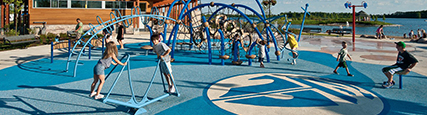
Community parks should be bustling with activity at dawn, yet certain corners remain forgotten—unused spaces along fences cluttered with debris, weeds overgrowing abandoned fitness equipment, children's areas overlapping with senior activity zones... These “dead zones” in aging parks not only squander precious public space but also fail to meet the recreational needs of citizens across all age groups. Non-powered facilities, with their core advantages of all-age accessibility, low implementation costs, and eco-friendliness, are emerging as the “golden solution” to this challenge, breathing diverse vitality into dormant spaces.
The “dead zones” in aging parks share four common pitfalls: fragmented spatial planning, aging and neglected facilities, limited functional diversity, and mismatched user needs. Traditional renovations often require millions in funding and tend to focus on single demographics, failing to accommodate the varied needs of children, seniors, and youth. Non-powered facilities overcome these limitations. Centered around climbing frames, fitness stations, resting swings, and accessible pathways, these structures require no electricity. Their modular design allows flexible assembly, filling narrow corners while revitalizing large vacant areas—achieving “one space serving multiple needs.”
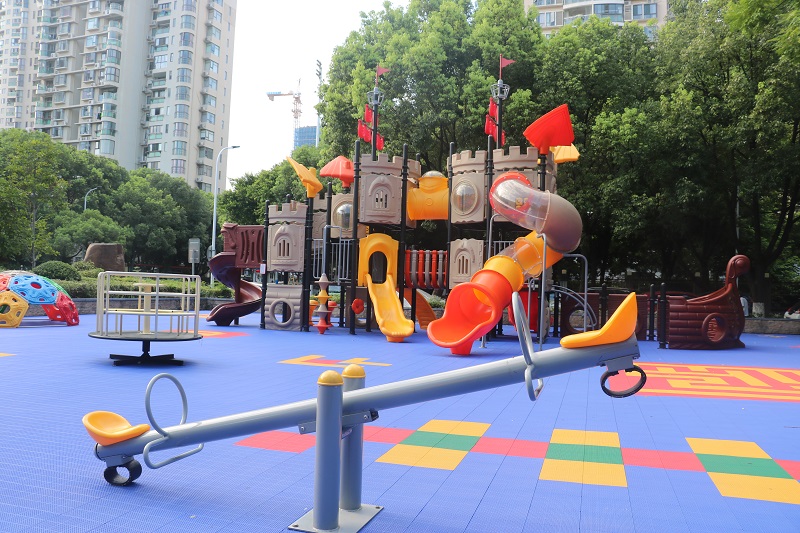
This site-specific renovation logic transforms non-powered facilities into “spatial magicians.” In a historic waterfront park in Hangzhou, a gently sloping area lay unused due to flood prevention requirements. Instead of extensive excavation, the renovation team leveraged the terrain's elevation to create a tiered non-powered complex: soft climbing mats and rocking horses for toddlers at the lower level, balance beams and climbing nets for adolescents in the middle section, and preserved native greenery topped with senior-friendly benches and chess tables at the highest point. The renovation cost just 450,000 yuan and took two months. After opening, daily foot traffic exceeded 800 visitors—a fourfold increase. Another example is the transformation of an abandoned basketball court in an old Guangzhou neighborhood park. By installing eco-friendly mats, adding a parent-child sandpit, a senior gateball area, and a youth frisbee zone, the single-purpose sports space became an all-age interactive venue. Maintenance costs dropped by 60% compared to traditional facilities.
The value of non-powered renovations extends far beyond revitalizing space. From a cost perspective, construction expenses are only one-quarter to one-third of traditional powered facilities, with no ongoing electricity consumption and annual maintenance costs under 1,000 yuan. In terms of adaptability, zoned designs cater to users aged 0 to 80, resolving the contradiction of “children crowding while seniors idle” in aging parks. Ecologically, the process preserves native vegetation and employs permeable paving to minimize disruption to existing ecosystems. Culturally, it integrates regional elements—such as Xi'an's transformation of an abandoned pavilion into the “Tang Dynasty Interactive Zone,” featuring traditional wooden spinning tops, bamboo slides, Tang-style murals, and poetry-themed light boxes, turning idle space into a cultural hub.
Successful non-powered renovations also require meticulous attention to detail: - Using food-grade eco-friendly materials to ensure child safety; - Installing accessible pathways and slip-resistant surfaces for seniors and individuals with disabilities; - Designating emergency evacuation zones to prevent overcrowding; - Conducting regular facility inspections to extend service life. For instance, during the renovation of an aging park in Suzhou, specially designed gentle ramps for wheelchair users were installed alongside height-adjustable seating, enabling special needs groups to enjoy recreational activities.
The “dormant corners” of aging parks are essentially untapped “public spaces.” Non-powered facilities offer a lightweight upgrade path for urban renewal through their all-age accessibility, low cost, and eco-friendly advantages. Looking ahead, as renovation concepts continue to evolve, more aging parks will likely overcome their “idle predicament.” Through non-powered upgrades, they can transform into “happiness spaces right at your doorstep”—places that serve all demographics, preserve urban memories, and promote ecological values.
+86-13566236059
#16 Chuangqiang Road, Light industrial area, Lucheng district, Wenzhou city, Zhejiang Province, China.
+86-577-85951908
+86-577-86457291