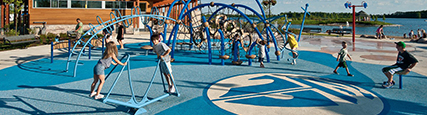
In the renovation of urban parks and community recreational areas, children's activity spaces often face the challenge of “pleasing everyone”—3-year-olds need safe, soft exploration zones, while 10-year-olds crave challenging physical play equipment. How can a single set of facilities accommodate the needs of children aged 3 to 12? Non-powered play equipment emerges as the optimal solution to this challenge. Leveraging its core strengths of modular layered design and high safety adaptability, it enables children of different ages to find joy within the same space.
Children aged 3-12 span a wide developmental range, with activity needs exhibiting distinct layered characteristics:
- Children aged 3-6 are in the sensory exploration phase, requiring low-intensity, high-safety, and highly engaging activity scenarios; Children aged 7-9, entering early school years, prioritize coordination training and social interaction, requiring group activity facilities offering moderate challenges; Children aged 10-12, in later school years, pursue physical breakthroughs and teamwork, favoring adventurous, multi-functional facilities. Traditional children's facilities often focus on single age groups, leading to wasted space or mismatched needs. Non-powered facilities overcome this through modular combinations enabling “multiple functions in one zone,” achieving full-age adaptability.
A qualified all-age non-powered facility hinges on “layered design + functional stacking.” Taking the renovation of a children's activity area in a Shanghai community park as an example, the project team created a “step-style non-powered combination facility.” Occupying just 80 square meters, it precisely meets the needs of children aged 3-12:
Early Childhood Zone (3-6 years): Features soft climbing mats, curved rocking horses, and low wooden tunnels. Constructed with food-grade PE materials and impact-resistant padding, all elements remain under 1.2 meters in height. Paired with textured anti-slip flooring, this area supports toddlers' crawling, tactile exploration, and balance training while enabling close parental supervision.
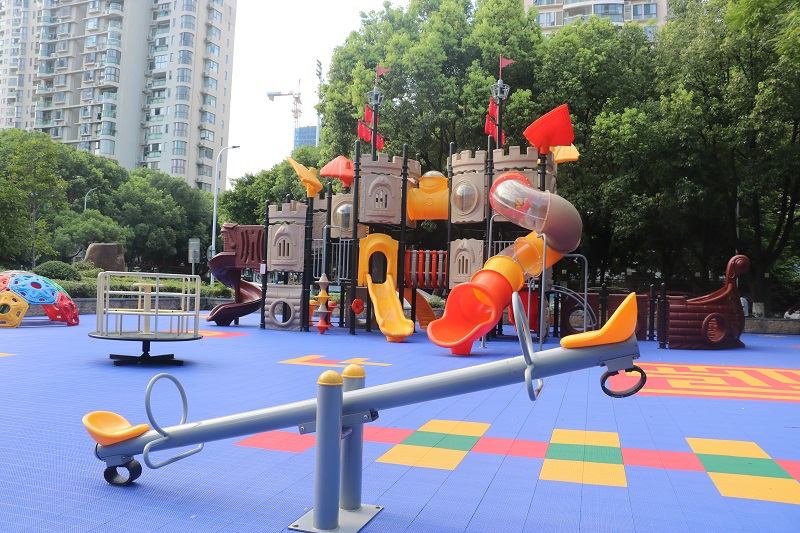
Mid-Age Zone (7-9 years): Adjacent to the younger zone, this area features medium-height climbing nets, balance beams, and two-person seesaws. Mesh spacing and platform widths are designed for child-sized grips and foot placement. Facilities are spaced 1.5 meters apart to create social interaction zones, encouraging cooperative play and enhancing motor coordination.
Older Children Zone (10-12 years): Features elevated climbing frames, rope walkways, and slide combinations, all under 3 meters in height. Equipped with non-slip handrails and cushioning platforms, these structures satisfy children's sense of adventure while minimizing safety risks through scientific design. Teamwork-focused facilities (e.g., multi-person swings) foster collective awareness.
The success of this facility hinges on three key design principles. First, safe material selection: The entire series uses eco-friendly materials like pressure-treated wood, food-grade plastic, and stainless steel, with no sharp edges, certified to meet national children's toy safety standards. Second, scientifically planned circulation: The younger children's zone is located near the entrance, while the older children's zone is positioned further inside. A soft green barrier separates the two areas, preventing activity conflicts between different age groups. Third, functional scalability: The modular design allows for future additions (such as sandboxes or chalkboards), adapting to the evolving needs of growing children.
Within the framework of child-friendly city development, a scientifically designed non-powered play structure not only revitalizes underutilized park spaces but also precisely meets the developmental needs of children aged 3-12. Moving forward, as design concepts evolve, these structures will increasingly incorporate educational elements and nature-based learning functions, transforming into comprehensive “outdoor playgrounds” that support holistic childhood development. This approach offers valuable reference solutions for urban public space renovations.
+86-13566236059
#16 Chuangqiang Road, Light industrial area, Lucheng district, Wenzhou city, Zhejiang Province, China.
+86-577-85951908
+86-577-86457291