Non-powered amusement equipment, due to its strong adaptability and low operation and maintenance costs, has become a standard facility in cultural and tourism scenic spots and communities. However, the market is flooded with manufacturers of varying quality, and frequent safety accidents are forcing procurement teams to focus on core safety standards. This article, from the manufacturer's perspective, breaks down safety regulations across four core dimensions: qualifications, materials, design, and testing, providing professional reference for procurement decisions.
Qualification certification is a prerequisite for safety compliance. When purchasing, priority should be given to verifying the manufacturer's core qualifications, including ISO9001 quality management system certification and GB/T 34272-2017 "Safety Specifications for Small Amusement Facilities" product certification. For large equipment in scenic areas, it is also necessary to confirm the Class A qualification for special equipment production. For international projects, additional attention should be paid to EU EN1176 series and US ASTM F1487 standard certifications. These manufacturers have a better understanding of age-appropriate safety and cushioning performance requirements in their designs, and can avoid approval risks. Be wary of small manufacturers with only basic business licenses and no certifications, as their products are prone to hidden dangers due to design flaws.
Materials and processes determine the bottom line of equipment safety. High-quality manufacturers adhere to stringent material standards: metal components are primarily made of 304 stainless steel, with 316 stainless steel used in highly corrosive coastal environments, and all components undergo hot-dip galvanizing for rust prevention, ensuring a service life of over 15 years; plastic components use food-grade HDPE material, passing EN71-3 hazardous substance testing to prevent heavy metal contamination. In terms of manufacturing processes, all edges and corners are rounded with a radius of curvature ≥5mm, welding points comply with ISO 9606-1 certification, connectors are concealed to prevent scratches, and the gaps in the climbing net are strictly controlled to <12mm or >25mm to prevent children's limbs from getting stuck.
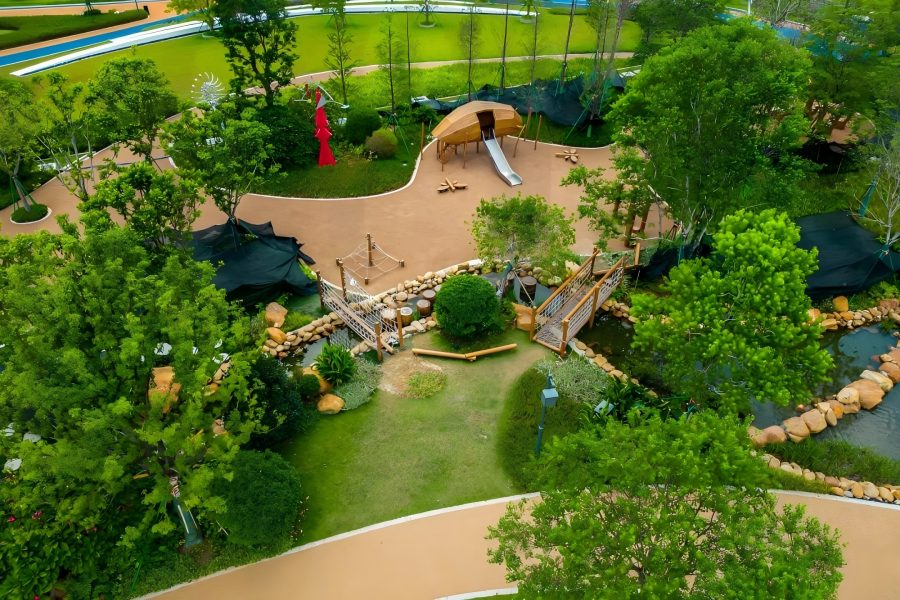
Scenario-based design is crucial for safe implementation. The needs of scenic areas and communities differ significantly, requiring manufacturers to adapt accordingly: in community areas for younger children, equipment height ≤1.2 meters, slide slope ≤30°, and a ≥30cm thick EPDM cushioning pad at the bottom; scenic areas can design high-altitude facilities as needed, but these must pass wind tunnel testing to withstand winds of force 8 or higher. General design specifications include: swing angle ≤ 75° for rigid structures; foundation depth ≥ 1.5 meters; crossbar spacing for climbing frames adapted to children's shoulder width; main reinforcement diameter of embedded parts ≥ 14mm; and in frozen soil areas, foundation depth and antifreeze additives are required.
Comprehensive testing is the ultimate guarantee of safety. Before leaving the factory, manufacturers must complete extreme load-bearing tests (slide support structure withstands 3 times the design load), 2000 hours of UV irradiation, and salt spray corrosion tests. After installation, third-party organizations such as TüV SüD must be commissioned to test the cushioning ground performance according to EN1177 standards. Furthermore, manufacturers must provide comprehensive maintenance plans, clearly defining the 6-month rust prevention inspection cycle for metal components and the annual aging test cycle for plastic components. Some reputable manufacturers also equip their systems with intelligent monitoring systems to provide real-time warnings of component wear.
Purchasing non-powered amusement equipment is essentially choosing a partner for safety responsibility. It is recommended to prioritize manufacturers with comprehensive quality control capabilities and extensive experience, incorporating detailed safety standards into the contract, and retaining the right to conduct material sampling and acceptance. This is the only way to build a solid safety barrier for tourists and residents.
+86-13566236059
#16 Chuangqiang Road, Light industrial area, Lucheng district, Wenzhou city, Zhejiang Province, China.
+86-577-85951908
+86-577-86457291