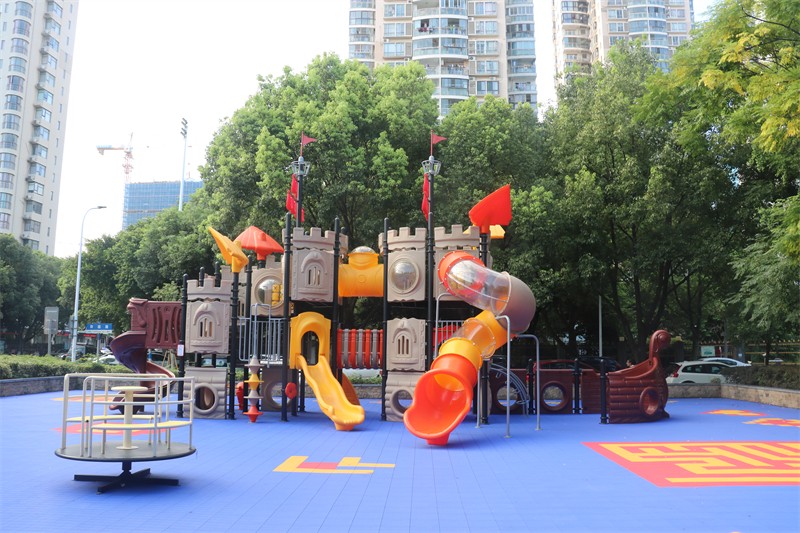
Large outdoor combination slides are a major draw for playgrounds and kindergartens, but their lifespan and safety performance heavily rely on a scientific installation process and a systematic maintenance system. Many operators neglect key aspects, leading to premature component aging and safety hazards. This article provides a comprehensive guide to long-term use, from installation preparation to daily maintenance and troubleshooting, helping to ensure the safety and durability of the facilities.
Installation preparation and standardized construction are fundamental guarantees. A site survey is essential beforehand. Kindergartens should avoid areas near school building entrances and green areas, while commercial playgrounds should plan the layout based on customer flow, ensuring the site's flatness error does not exceed 3cm to prevent uneven structural stress later. Qualification verification is crucial; the installation team must possess a "Special Equipment Installation, Modification and Repair License," and core components such as slide panels and climbing frames must provide material testing reports (e.g., food-grade PE, corrosion-resistant steel certification). During construction, the concrete base depth must be at least 80cm, bolt tightening torque must meet design standards (usually not less than 150 N·m), and joints should be sealed with sealant to prevent rainwater seepage and corrosion.
Routine inspections are the first line of defense in identifying potential hazards. It is recommended to establish a "daily inspection + weekly inspection" system: daily inspections should focus on easily worn parts, such as loose handrails, scratches on the slide surface, and damaged cushioning mats; any sharp protrusions should be immediately sanded smooth. Weekly inspections should focus on structural safety, checking for detached welds at steel frame joints and rust on connectors, and repairing any peeling paint with anti-rust paint. Kindergartens need to pay extra attention to disinfection, wiping contact areas daily with a neutral disinfectant to prevent bacterial growth; commercial playgrounds should focus on high-load areas, such as the lubrication of rotating slide bearings, and replenishing with dedicated lubricating oil as needed.
Seasonal deep maintenance is directly related to extending lifespan. High summer temperatures can cause plastic parts to age; a UV protectant should be sprayed monthly, and water inside the slide should be cleaned to prevent moss growth. Low winter temperatures may increase the brittleness of the steel frame; avoid impacts with heavy objects, and promptly clear snow after snowfall to prevent icing and slipping. A comprehensive disassembly and maintenance should be performed every six months, replacing aging sealing strips and worn anti-slip pads, and carrying out overall rust removal and anti-corrosion treatment on the steel frame. In addition, a maintenance log should be established to record the time of each maintenance and the parts replaced, providing a basis for subsequent inspections.
Efficient and professional emergency handling is essential. If serious problems such as cracked slide panels or deformed steel frames occur, warning signs should be immediately set up and use suspended. The original manufacturer's after-sales team should be contacted for repairs to avoid self-welding modifications. For minor faults, such as displaced cushioning mats, professional personnel can re-secure and reinforce the edges.
In short, the long-term use of large outdoor combination slides hinges on a complete management chain: standardized installation in the early stages, precise inspections in the mid-term, and scientific maintenance in the later stages. Only by consistently prioritizing safety details can user safety be guaranteed while maximizing the value of the facility.
+86-13566236059
#16 Chuangqiang Road, Light industrial area, Lucheng district, Wenzhou city, Zhejiang Province, China.
+86-577-85951908
+86-577-86457291