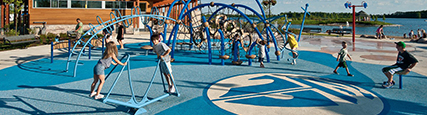
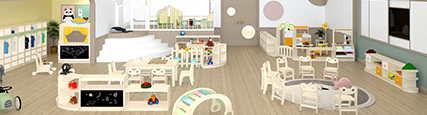
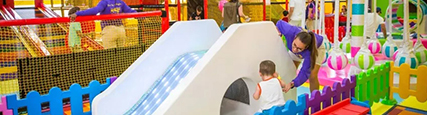
Large children's playground equipment is a core component of parks, communities, kindergartens, and other similar venues, and its materials directly determine its safety and lifespan. Parents and operators must consider the safety, durability, and suitability of the materials when purchasing to avoid safety hazards or frequent repairs due to material issues. The following is a targeted material selection guide to help you choose high-quality, safe, and cost-effective large children's playground equipment.
Plastic materials are commonly used in large children's playground equipment, with food-grade PE and PP being the mainstream materials. These materials are non-toxic, odorless, and highly impact-resistant, effectively cushioning children's impacts and preventing serious injuries. They are also corrosion-resistant, colorfast, and suitable for outdoor humid and sun-exposed environments. When purchasing, avoid recycled plastics, as they are prone to aging and cracking, and have insufficient load-bearing capacity. Quality can be judged by observing the material's color (uniform and translucent is preferable) and checking test reports (free of formaldehyde and other harmful substances). These materials are suitable for slides, swing seats, and other parts that come into contact with children's bodies.
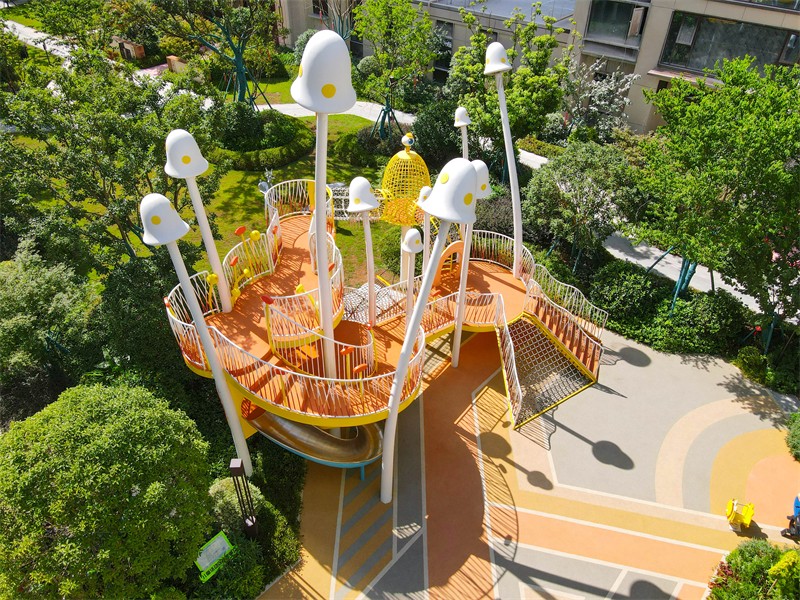
Metal materials are mostly used for the frame structure of large children's playground equipment, commonly stainless steel and galvanized steel. Stainless steel offers excellent rust resistance, making it suitable for rainy and coastal areas. Its outstanding load-bearing capacity ensures the overall stability of the facility. Galvanized steel, after hot-dip galvanizing, provides superior corrosion resistance and offers better value than stainless steel, making it widely used in climbing frames and modular facility supports. It is crucial that the edges and corners of metal components be rounded and blunted to prevent sharp edges from injuring children. Also, check the strength of welds to prevent them from detaching after prolonged use.
Wood, with its natural texture, is suitable for creating immersive play environments. Commonly used woods include preservative-treated wood and teak. High-quality preservative-treated wood undergoes high-pressure preservative treatment, resisting insect infestation and moisture deformation, with a lifespan of over 10 years. Teak wood is harder and more wear-resistant, but more expensive. Large wooden children's playground equipment requires regular application of preservative paint for maintenance to prevent cracking and water seepage. Ensure the wood surface is smooth and free of burrs, and that joints are secure. This makes it suitable for outdoor locations such as parks and ecological scenic areas.
Rubber is primarily used for protective accessories on large children's playground equipment, such as ground cushioning mats and anti-slip handrail covers. Prioritize environmentally friendly EPDM rubber, which is odorless, highly elastic, and effectively reduces the risk of injury to children from falls. It is also wear-resistant, UV-resistant, and does not easily age. Avoid using inferior recycled rubber, which may contain heavy metals and other harmful substances, and has poor elasticity and is prone to shedding. When purchasing, you can judge the quality by pressing the rebound speed and smelling the rubber.
In summary, the selection of materials for large children's playground equipment should be precisely tailored to the usage environment (outdoor/indoor) and the children's age group. Prioritize materials that meet the national "Safety Standards for Children's Playground Equipment," while also considering durability and safety. Regular material maintenance by the operator can further extend the lifespan of the equipment, creating a safe and secure play space for children.
+86-13566236059
#16 Chuangqiang Road, Light industrial area, Lucheng district, Wenzhou city, Zhejiang Province, China.
+86-577-85951908
+86-577-86457291