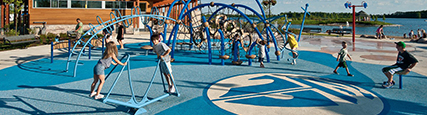
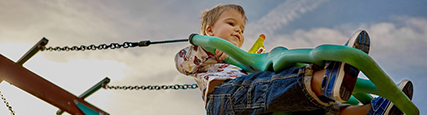
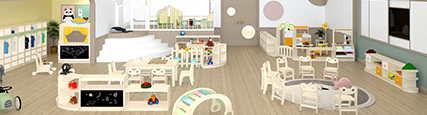
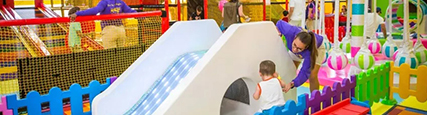
Non-powered amusement facilities in parks are a core attraction for family outings, and their operational effectiveness directly impacts the park's reputation and visitor traffic. For operators, "low maintenance costs" and "high child participation" are two core requirements, and achieving these hinges on the initial material selection and subsequent operational strategies. Scientific material selection reduces wear and tear from the outset, while a comprehensive operational plan extends the facility's lifespan; combining these two elements creates an efficient operational system.
Material selection is fundamental to achieving "low maintenance and high participation," requiring consideration of weather resistance, safety, and interactivity. Hot-dip galvanized steel is the preferred choice. Its high-temperature galvanizing process forms a dense, corrosion-resistant layer, resisting rust in the park's humid environment. Even with long-term exposure to wind and rain, its annual maintenance cost is only one-third that of ordinary steel. This material can be used to construct large facilities such as climbing towers and zipline supports, providing a stable structure that can support multiple people interacting simultaneously, thus enhancing participation efficiency.
Solid wood with preservative treatment is an ideal choice for parent-child interactive facilities. After vacuum pressure preservative treatment, it effectively resists insect infestation and mold, and is suitable for swing seats, balance beams, sandpit fences, and other facilities. Its natural texture matches the ecological atmosphere of a park and can be designed into modular, building-block-like structures, allowing children to assemble and play independently, enhancing their sense of participation. Maintenance only requires annual surface varnishing, which is simple and inexpensive.
HDPE engineering plastic is considered a "low-maintenance star material." Its food-grade environmentally friendly properties ensure children's safety when chewing on it. It has excellent UV resistance and anti-aging capabilities, and is not prone to cracking or deformation under direct sunlight or low temperatures. It can be processed into slides, rocking toys, etc., with bright colors and customizable cartoon shapes, significantly attracting children. The surface of this material is smooth and can be cleaned with just water, requiring almost no special maintenance.
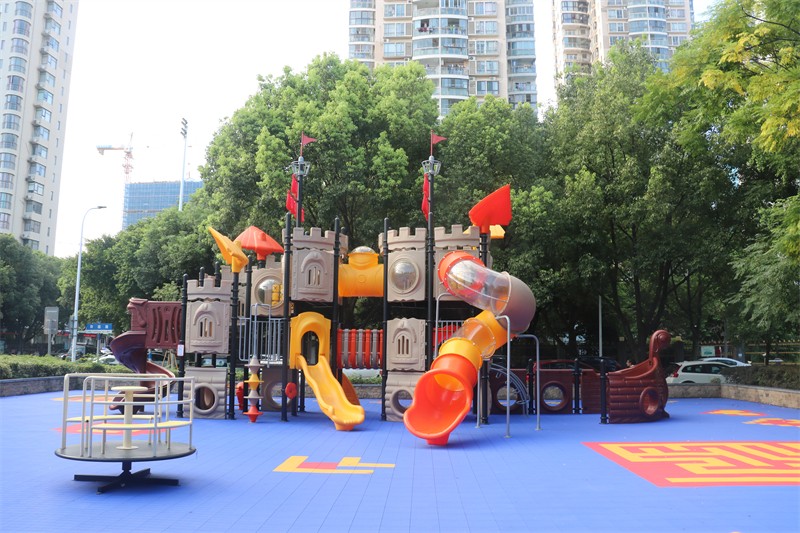
A long-term operation plan requires building a comprehensive "prevention-control-optimization" system. Routine maintenance employs a "zoning inspection system," dividing the play area into high-wear zones (e.g., slides, swings) and stable zones (e.g., climbing nets). High-wear zones undergo daily checks of connector tightness and surface wear, while stable zones are inspected weekly, with any loose screws or material damage addressed within 24 hours.
A "tiered maintenance strategy" is implemented. Core facilities, such as large climbing structures, undergo comprehensive maintenance quarterly, including reapplying anti-corrosion coatings and lubricating moving parts. Auxiliary facilities, such as seesaws, have key components replaced every six months. Furthermore, "user-participatory maintenance" is introduced, with suggestion boxes placed near facilities to encourage parents to report issues. Those providing valid feedback receive small gifts, fostering a co-governance model between the operator and the public.
In addition, operational details are optimized based on material characteristics: metal facilities are promptly dried and rust-removed after the rainy season; solid wood facilities are kept away from sprinkler areas to reduce moisture damage; and plastic facilities are regularly cleaned of surface dust to prevent UV aging. Annual facility assessments are conducted, and facilities with low participation rates are phased out based on participation data, with damaged parts replaced with standardized modules to reduce replacement costs.
The efficient operation of non-powered amusement facilities in parks is never a crude model of "heavy investment and light management," but rather the synergistic result of "precise selection + scientific operation." High-quality materials lay the foundation for low maintenance, while sound operation ensures continuous high participation. Following this approach not only keeps the facilities in a consistently interactive state but also significantly reduces operating costs, becoming a key measure for parks to enhance their core competitiveness.
+86-13566236059
#16 Chuangqiang Road, Light industrial area, Lucheng district, Wenzhou city, Zhejiang Province, China.
+86-577-85951908
+86-577-86457291