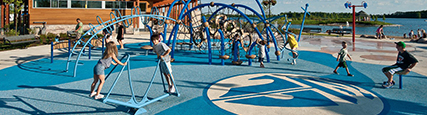
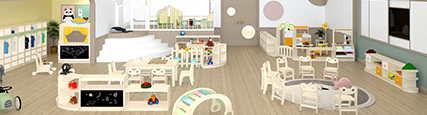
Large outdoor combination slides are core play facilities in kindergartens and commercial playgrounds, but their design logic differs greatly due to their different scene positioning and target audiences. The former focuses on children aged 3-6, with safety and suitability as the primary principles; the latter caters to all age groups, making experience and appeal key design considerations. The following analyzes the design differences between the two from five core dimensions.
The fundamental difference in safety standards is the dividing line in design. Kindergarten slides must comply with the "Technical Specifications for Safety of Children's Furniture," and the material must be food-grade PE to avoid the release of harmful substances such as formaldehyde. All joints must use rounded transitions with a chamfer radius of no less than 5mm to prevent children from bumping into them. The height must be strictly controlled at 2-3 meters, the slide slope must not exceed 30°, the bottom must be equipped with a 5cm thick EPDM cushioning mat, and the guardrail spacing must be fixed at 10cm to eliminate the risk of fingers being pinched. Commercial playgrounds adhere to the "Safety Standards for Amusement Facilities," emphasizing structural durability. They often utilize steel frames combined with engineering plastics, and can design slides with drops exceeding 5 meters. The buffer layer is primarily made of wear-resistant rubber. Monitoring systems and emergency exits are also added to handle large crowds.
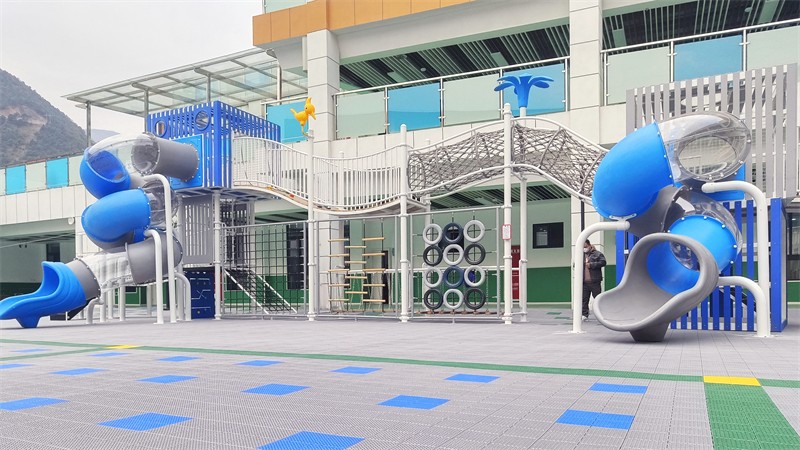
Personal suitability dictates the functional design direction. Kindergarten slides need to be appropriate for children's cognitive and physical abilities, incorporating cartoon shapes (such as animal heads or fairytale castles). Low steps and handrails are provided at the slide entrance, along with simple climbing nets and tunnels to cultivate children's coordination. Commercial playgrounds, on the other hand, aim for "all-age coverage," with a tiered structure: a lower area with gentle slides specifically for young children, and a middle to upper area with more exciting attractions such as wave slides and spiral slides. They also include parent-child interactive modules (such as double slides and cooperative climbing frames), along with rest areas and photo opportunities to enhance family engagement.
Spatial integration and operational needs also differ significantly. Kindergarten slides are mostly modular, occupying only 20-30 square meters, allowing for flexible adaptation to limited park spaces. They primarily use soft pastel colors to complement the teaching environment. Commercial playground slides, on the other hand, emphasize themed designs, such as jungle adventures or space exploration themes, occupying 50-100 square meters. They often serve as landmarks within the park, using highly saturated colors to attract attention. In terms of maintenance, kindergarten slides need to be easy to clean and disinfect, with replaceable components; commercial playground slides prioritize wear and damage resistance, employing anti-corrosion coatings and sealed structures to reduce maintenance costs under high-frequency use.
In summary, the core design principle for kindergarten slides is "safety and adaptability," using meticulous details to protect children's growth; the core principle for commercial playground slides is "experience and attraction," using diverse designs to draw in customers. Although significantly different, both must be based on "scenario needs" to realize the core value of playground equipment.
+86-13566236059
#16 Chuangqiang Road, Light industrial area, Lucheng district, Wenzhou city, Zhejiang Province, China.
+86-577-85951908
+86-577-86457291